STANDARDIZATION AND OPTIMIZATION OF PRINTING
Print standardization combined with optimization aims to achieve consistent quality in print reproduction in accordance with defined international and industrial standards. Our implementation of print standardization is based on ISO 12647 standards, depending on the printing technology.
Standardization of printing offered by CMC covers all stages of the printing reproduction process: 1) prepress-plate; 2) making-press-postpress-proofing; 3) ink mixing; 4) quality control, which allows extending this service to include production optimization, enabling the reduction of waste and setup time.
What stages does
print standardization include?

Print standardization is preceded by a print shop audit aimed at assessing the current situation; this includes evaluating how existing hardware and software functionalities are used, as well as the knowledge and skills of the people operating the system.
The preliminary audit concludes with a report identifying areas within the process that should be covered by standardization and optimization to improve printing production efficiency and quality. The report contains an assessment of the current production performance, the capabilities of the equipment and software available in the print shop, an evaluation of existing SOP procedures, and the knowledge and skills of the personnel operating the system. Based on the audit, we can develop a comprehensive cooperation offer tailored to the client’s needs.
Print standardization enables the integration of individual production stages into a smoothly functioning ecosystem. The various production departments are connected through digital color standards, and the reporting system verifies quality and consistency throughout the entire print run, both for CMYK triadic colors and spot colors such as Pantone.
Standardization combined with production optimization — including preliminary ink settings for CMYK and Pantone—allows for reducing waste and setup time necessary to complete a job.
We carry out print standardization projects that culminate in certification according to ISO 12647-2:2013 and European color standards Fogra 39, Fogra 51, and Fogra 52. We also handle print standardization projects preparing print shops for implementing the Color Management Program Certification (CRCP), compliant with G7, GRACoL2013 NPDC G7 Idealliance, across four levels of conformity.
- Basic G7 Grayscale Calibration,
- G7 Targeted Calibration,
- G7 (Colorspace) Calibration,
- G7 Extreme Calibration.
01 Audit - covering all stages of the printing house’s production process.
- It allows identifying critical points where print standardization and SOP control procedures need to be implemented.
- It allows for the assessment of the knowledge and skills of the personnel.
- It allows for preparing a personalized offer tailored to the machinery park as well as the knowledge and skills of the operators handling the system.
covering all stages of the printing house’s production process.
02 PrePress – print preparation
- Calibration of the existing system or implementation of a proofing system
- Stabilization of image information flow, saving production files
- Preliminary file inspection
- Monitor calibration, soft proofing
– print preparation
03 PLATE MAKING - PROCESS CONTROL OF CTP PLATE PRODUCTION
- Assessment of the stability of the CTP system’s operation
- Selection of rastering parameters tailored to the nature of production and the capabilities of the workflow.
- System linearization
PROCESS CONTROL OF CTP PLATE PRODUCTION
04 .1. PRESS - OFFSET PRINT
- Lighting audit according to ISO 3664:2009
- Mechanical audit of the printing machine, mechanical control of pressure settings using the NIP control probe
- Assessment or selection of dampening solution parameters
- Assessment or selection of the optimal water-ink balance using analytical forms (ink-solution-rubber blanket-plate).
- Optimization of the preliminary CIP3 ink preset on the press for zone opening and ductor roller rotation.
- Determination of spectral print parameters Lab CMYK/RGB in accordance with ISO 12647-2:2013
- Determination of TVI correction curves, averaging data according to ISO 12647-2:2013 or NPDC G7 Idealliance standardization at four levels of conformity:
- Basic G7 Grayscale Calibration,
- G7 Targeted Calibration,
- G7 (Colorspace) Calibration,
- G7 Extreme Calibration - Confirmation of optical compliance with digital data in the report
- Optionally, the creation of ICC profiles, Device Link profiles, and simulation at the proofing stage.
- Implementation of a reporting system for evaluating production quality and efficiency
OFFSET PRINT
05 .2. PRESS - FLEXOGRAPHIC PRINT
- Qualification and preparation of the flexographic machine for calibration
- Diagnosis of the mechanical condition of the machine using analytical forms enables the assessment of parameters such as: ink coverage uniformity, pressure consistency, pressure repeatability, repeatability of highlight reproduction, repeatability at different printing speeds, tonal value analysis, and registration accuracy between colors and printing units.
- Selection of raster roller parameters according to the target standard guidelines
- Selection of compensating parameters for mounting tapes
- Optimization of the print speed parameter
- Optimization of the printing pressure parameter — adjustment during printing
- Maintaining high repeatability in spot color reproduction using the guidelines of the PANTONE Certified Printer Program
- Defining SOP (Standard Operating Procedures) for standardized production
- Determination of TVI curves vs NPDCS G7 Idealliance at four levels of compliance: - Basic G7 Grayscale Calibration, - G7 Targeted Calibration, - G7 (Colorspace) Calibration, - G7 Extreme Calibration
FLEXOGRAPHIC PRINT
06 INK MIXING ROOM
- Implementation of digital color standards for spot colors according to the Pantone Certified Printer Program methodology for individual colors based on .CxF X4 files
- Implementation or improvement of communication between the ink mixing room and the press regarding color standards based on .CxF/X-4 files, as well as automation of separation data embedding in production files.
- SCTV calibration, controlled dot gain for spot colors according to ISO 20654 – Spot Color Tone Value.
07 POSTPRESS – ONGOING QUALITY CONTROL
- Cyclical monitoring of the implemented standardization and maintaining production quality throughout the entire operational cycle of the printing process.
- Process optimization aimed at minimizing waste and reducing production setup time
- Analysis of production reports, evaluation of operator performance and work quality
- Implementation of appropriate SOP procedures at each stage of production
– ONGOING QUALITY CONTROL
What are the benefits of a well-executed standardization process?
The ability to reproduce a color gamut as closely as possible across different printing techniques
Consistent product quality
Lower production setup costs
High conformity with the proof print
Minimization of the risk of color-related complaints
The ability to compete for more demanding clients
Consistent printing across different printing machines and substrates
Reduction of waste and setup time
Precise reproduction of spot colors based on digital color standards
Faster machine inking
The possibility to confirm optical compliance through production reports
Print optimization allows the integration of individual production stages into a smoothly functioning ecosystem. The various production departments are connected through digital color standards, and the reporting system verifies quality and consistency throughout the entire print run, both for CMYK triadic colors and spot colors, such as Pantone.
Every printing device has its own individual characteristics which, when combined with different components and various printing substrates, can cause different increases in halftone dot gain, resulting in a different printed image. Print standardization enables the entire printing process to be arranged so that, regardless of the substrate, inks, or printing technology used, the same consistent effect is achieved, in accordance with the intended target standards or color profiles. We carry out print standardization projects that culminate in certification according to ISO 12647-2:2013 and European color standards Fogra 39, Fogra 51, and Fogra 52. Additionally, we handle print standardization projects that prepare print shops for the implementation of the Color Management Program Certification (CRCP), which is popular in the American market. We also conduct audits for compliance with G7, GRACoL2013 NPDC G7 Idealliance across four levels of conformity:
- Basic G7 Grayscale Calibration,
- G7 Targeted Calibration,
- G7 (Colorspace) Calibration,
- G7 Extreme Calibration
Standards and norms provide us with reference printing parameters that we should strive to achieve, and they include defined tolerances for those parameters.

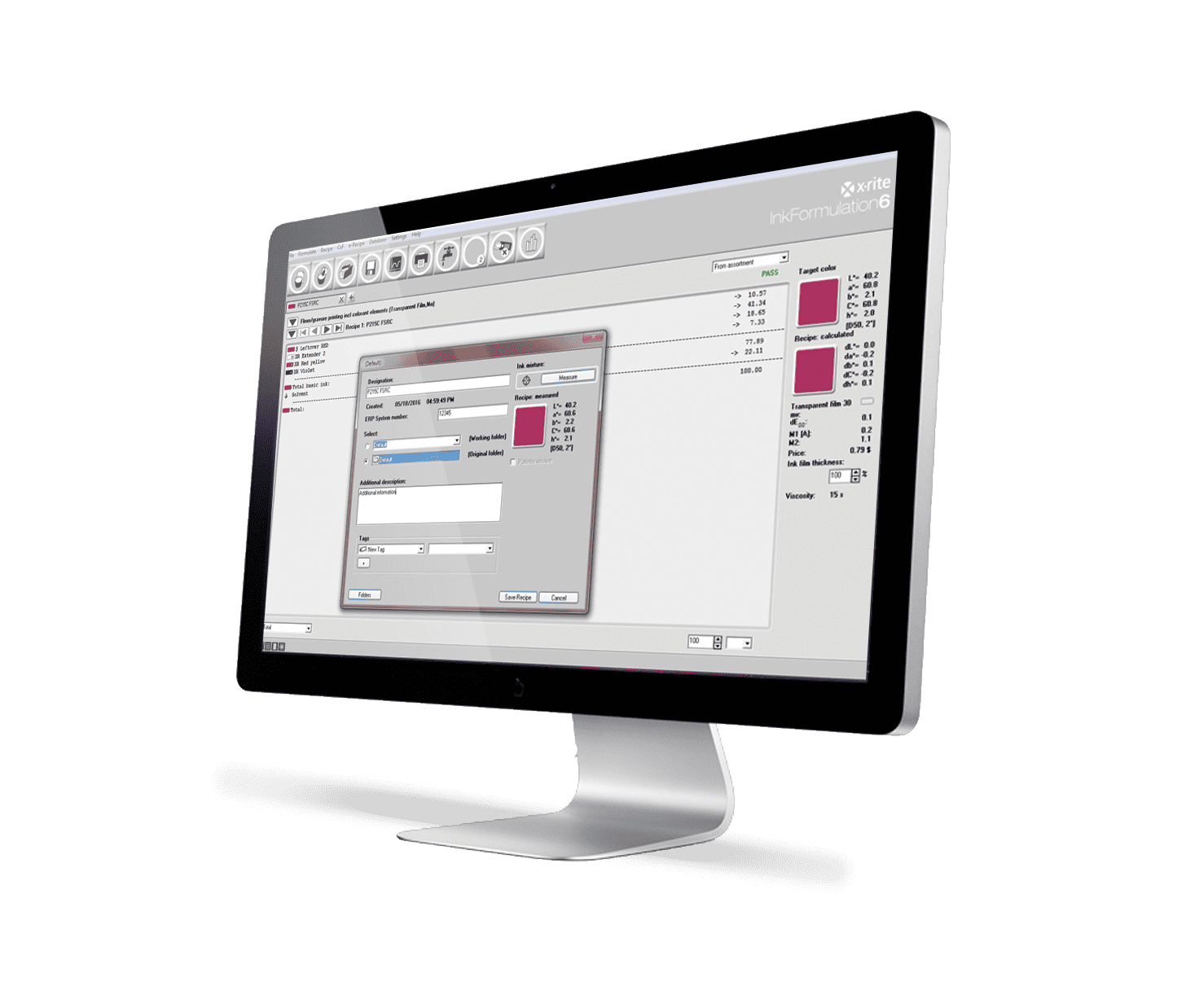
The print standardization implemented by CMC aims to introduce lasting changes that won’t revolutionize the printing house’s work but will allow the printing process to evolve according to defined principles. Standardization primarily means optimizing and organizing the flow of color information; the "zero" parameter here is undoubtedly the international standard, but this should not be the sole or overriding goal of print standardization—rather, it should serve as a reference point that facilitates identifying its final outcomes.Print standardization is controlled using measurement devices, and its effects are visible in the results recorded in specially dedicated software. The quality of standardization and the achieved level of compliance with the standard are documented in a detailed report.Print standardization is carried out by our company’s employees, who also provide ongoing support, including a telephone hotline, direct service, or remote service. The goal of print standardization is to demonstrate better performance results while maintaining color consistency with international standards, thus ensuring the highest possible production repeatability. Our implementations are comprehensive and cover all stages of production, with collaboration being cyclical in nature.
Print standardization is preceded by a print shop audit aimed at assessing the operation, equipment, and efficiency of individual production stages.Additionally, the audit allows us to preliminarily evaluate the range of functionalities available in the printing machine’s software, RIP, workflow, as well as the equipment and software we can utilize in the print standardization and production optimization process.We analyze the possibilities of transmitting .CxF files at various production stages, examine data sent to the print shop from the ink mixing room, and implement their digitization to ensure the highest possible consistency and repeatability, minimizing the printer’s workload during the process of achieving conformity for spot or triadic colors. This time is, after all, the most costly, and failing to leverage process automation and machine functionalities results in wasting it by achieving positive results through trial and error.


The next step is analyzing production reports based on information from the control strip measurements taken on the press. These reports provide valuable insight into the actual quality and efficiency of the process, showing how many sheets were used to achieve a so-called “OK” print.Based on these reports, we assess the initial ink coverage of the press relative to the target guidelines. If the results are consistent across most jobs within a given month, we see the opportunity to offer the client ink coverage optimization and a reduction in waste by a specific amount. Depending on the type and volume of production, this can save anywhere from tens of thousands to a million PLN—calculating ROI based on concrete data.Process optimization is essential and, in an era of shrinking print runs, can be crucial for job profitability. The amount of waste required to achieve a compliant print should be as low as possible, while print quality should remain consistent with international and industry standards. As an X-Rite dealer, we sometimes equip printing houses with the necessary measurement equipment and software required to carry out the optimization process.
During the assessment of the current situation in the printing house, we also analyze the technical condition of the machine and the selection of printing components.In practice, we often encounter situations where printing components are chosen with little awareness of their impact on the production process and its final outcome. Usually, their selection is driven by economic reasons or biased advice from sales representatives. Meanwhile, without stabilizing the printing machine’s operation, further actions may prove pointless. Therefore, the preliminary audit allows for proper preparation to carry out the task and provides an effective answer to how to prepare for the print standardization process and to what extent it should be implemented for a given client.The scope of work is never identical; it depends on the quality of the equipment and software found in the printing house, as well as the knowledge and skills of the people operating the reproduction process.During the audit, we also talk with the staff, allowing us to assess their knowledge level, engagement, and to tailor the training scope for the printing or quality control departments. Training for salespeople is often also necessary to enable smooth communication with clients.
Request an audit offer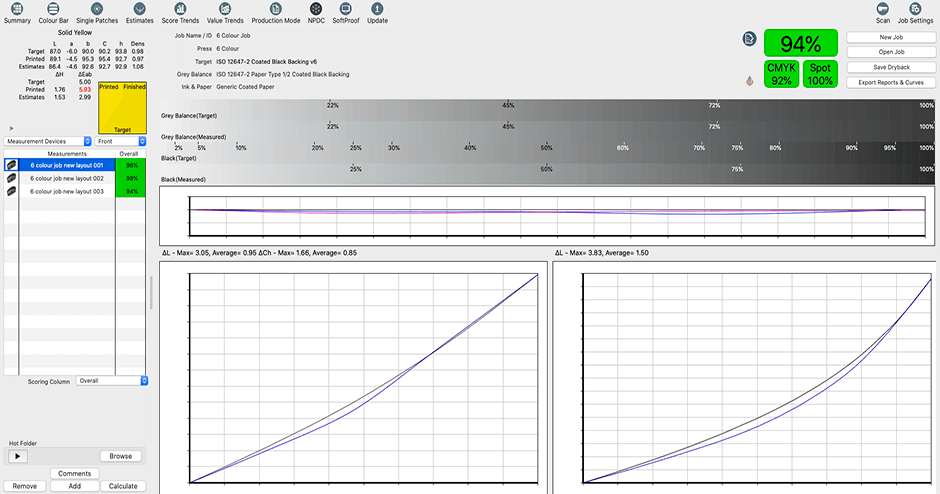

Standardization and optimization
of flexographic production
The standardization process covers all stages of flexographic production – from file preparation, through printing, to the final quality control of the product.
The greatest benefit of implementation is the ability to maintain consistent production in compliance with international and industry standards while minimizing setup time and reducing waste to a minimum.
01 PrePress - print preparation
- Calibration or verification of the proofing system’s compliance
- Stabilization of image information flow
- Optionally, monitor calibration and soft proofing
- Lighting audit at the press according to ISO 3664:2009
print preparation
02 PLATE MAKING - PROCESS CONTROL OF CTP PLATE PRODUCTION
- Selection of rastering parameters tailored to the nature of production and the capabilities of the workflow
- Linearization of the Vip Flex system + 3D surface analysis of the halftone dot
- Performing corrections on-site or at a service-based plate-making facility
PROCESS CONTROL OF CTP PLATE PRODUCTION
03 PRESS - PRINT
- Qualification and preparation of the machine for calibration.
- Stabilization of production conditions.
- Diagnosis of the mechanical condition of the machine using analytical forms allows for the assessment of parameters such as: ink coverage uniformity, pressure consistency, repeatability of pressure, repeatability of solid area reproduction, repeatability at different printing speeds, tonal value analysis, and registration between color printing units.
- Selection of anilox roller parameters according to the target standard guidelines.
- Selection of compensatory mounting tape parameters.
- Optimization of the printing speed parameter.
- Optimization of the pressure parameter – impression settings in printing.
- Maintaining high repeatability of spot color reproduction using the guidelines of the PANTONE Certified Printer Program.
- Establishment of SOP for standardized production.
- Determination of TVI curves vs NPDCS G7 Idealliance at four levels of compliance:
- Basic G7 Grayscale Calibration,
- G7 Targeted Calibration,
- G7 (Colorspace) Calibration,
- G7 Extreme Calibration
PRINT
04 POSTPRESS - ONGOING QUALITY CONTROL
- Maintaining digital and visual conformity of production with the defined standard.
- Recalibration of the production process using the G7 and PSO TVI methods.
- SOP for process control methods, implementation of quality verification methods for process (CMYK) and spot colors.
- Minimizing waste and setup time in roll-to-roll production.
- Digital color standards at all stages of production, CxF/X-4.
- Implementation of SCTV curves for spot colors in production.
- Verification of the optimized process against the machine's limit parameters during printing.
- Implementation of reporting for ongoing quality control and print process performance monitoring.
ONGOING QUALITY CONTROL
ACCEPTANCE OF NEW AND USED PRINTING MACHINES
The analysis is conducted based on the guidelines contained in the technical directive for the acceptance of sheetfed offset printing presses, referring exclusively to measurable technical printing parameters.
Send a quote requestMEASURABLE TECHNICAL
PRINTING PARAMETERS
- Register on the feeder (longitudinal and lateral)
- Register on the transfer in single-sided printing
- Machine register (longitudinal and lateral)
- Sheet slippage/doubling
- Tone value increase
- Dot gain difference between printing units
- Stability of tone values in relation to printing units
- Variation of optical density across the sheet
- Moiré patterns
- Banding
TECHNICAL
DIRECTIVE
The technical directive facilitates communication between machine manufacturers and offset printing houses in technical discussions and commercial negotiations. Additionally, it provides a testing framework for the technical and measurement-based acceptance of machines.


X-GAMUT
IMPLEMENTATIONS

X-GAMUT significantly streamlines the production process.
This means you no longer need to deal with special color formulations or implement an ink mixing room. There’s no need to wash the press, and changeover times are eliminated. Production setup time is also reduced. As a result, the software helps lower overall costs—for both businesses and their clients.
IMPLEMENTATIONS of Extended Color Gamut Printing (ECG)
based on the Fogra 55 Colour Exchange Space profile
- Replace spot color reproduction with ECG technology based on CMYKOGV printing
- Reduce machine setup time for spot colors
- Lower production costs for spot colors
- Increase the number of production jobs during a shift
- Increase OEE for your machines while maintaining reproduction accuracy for spot colors
Our implementations are based on CGS Oris solutions.
Receive an implementation offer.